Braid fishing line is not just braided line. What I mean by that is, Braid A can be composed one way and perform entirely differently than Braid B. Unlike monofilament or fluorocarbon, braid fishing line varies much more significantly from style to style, brand to brand. On a basic level, all braided line consists of strands of synthetic material woven together. It has virtually no stretch as compared to monofilament or fluorocarbon, which allows for ultimate sensitivity. Most braid is also made of buoyant material and floats. It is thinner than monofilament or fluorocarbon, and has a higher breaking strength at a smaller diameter. For example, a 20-pound test braid may have a diameter of .23 millimeters, whereas a 20-pound monofilament could have a diameter as high as .45 millimeters. This slimmer line allows for more capacity on the spool at a higher breaking strength as well as a faster sink rate.
Selecting Strands of Braided Fishing Line
We know now that braided line is composed of a series of strands woven together. However, it’s important to know how many strands make up the line before selecting the right one for your purposes. The most common options are: four-strand, eight-strand, and nine-strand (also known as eight-plus-one-strand).
Four-strand braid is rougher to the touch, making it more abrasion resistant than lines with a higher strand count. The caveat, however, is that the coarser construction causes more friction when coming through the rod guides and can hinder maximum potential casting distance. An example of this type of line is original Power Pro.
Eight-strand braid is smoother to the touch and comes cleanly through the guides, allowing for longer casts. But, being silkier than four-strand line, it will in turn be less abrasion resistant. Suffix 832 is a popular option. Finally, we have nine-strand braid (eight-plus-one-strand). This line is constructed very similarly to eight-strand, but with an added core strand. What we’re left with is the smoothest, longest casting option of the three different types of braid discussed thus far. In turn, though, nine-strand will be the least resistant to abrasion. A common choice is Berkley X9.
Braid Fishing Line Diameter
As we mentioned previously, braided line generally has a thinner diameter than monofilament, allowing for more mainline capacity and a faster sink rate. However, diameter varies even further from braid to braid, even those composed of the same number of strands. Take two of Power Pro’s four-strand options as an example. Power Pro Max Cuatro 20-pound line is .19 millimeters thick in comparison to original Power Pro, which comes in at .23 millimeters. This may seem like a minute difference, however the increased line capacity and sink rate of Max Cuatro is highly noticeable when comparing the two. It’s important to note, though, that the thinner the braid you go with, the tougher it will be to tie knots and the more tangles you may experience when casting, especially in windy conditions.
Choosing Color
There is and always will be a great debate among the fishing community as to how much line color really matters to fish. It’s most important when tying lures directly to braid, in which case I recommend matching the hue of the water. When fishing the Bay, go with a moss green. When fishing the ocean, a blue may provide more camouflage.
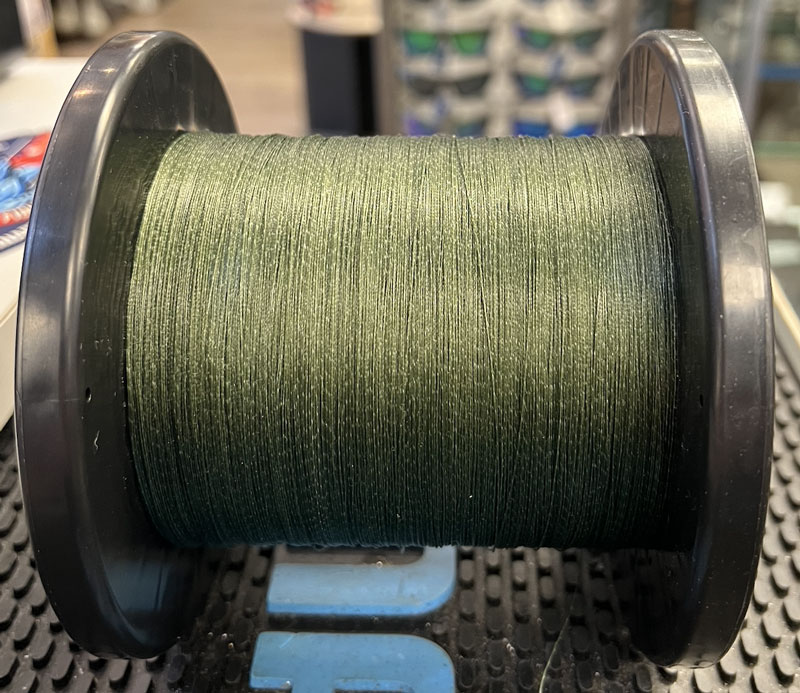
If you’re using a low-visibility fluorocarbon or monofilament leader, it’s my belief that mainline color makes little difference in terms of getting bites. Rather, it matters much more to the angler. Brightly colored lines like yellow are great for a variety of reasons. Tactics which may require you to watch your line to detect bites will be improved by using a colored line that is easy to see. Untangling lines or tying knots is also generally less painful when you can see the line most clearly. Lastly, bright colors will catch the moonlight and allow for better visibility during night-fishing adventures.
Another option is going to be metered line, where the color changes by increments. For example, an offering from Daiwa J Braid features a color change every ten meters. This allows for anglers fishing vertically to count down the exact depth at which their lure or baits will be.
Spooling Up Braid Fishing Line
There are several nuances that go into selecting the right braid for your mode of fishing and the species you plan to target. Let’s say you’re fishing shallow water structure for rockfish during the summertime. Abrasion resistance is going to be important here, so you’ll want to use a leader. That means we can use a high-visibility line color. For added abrasion resistance around rocks, docks, and oyster beds, a four-strand braid is ideal. So, we’ll spool up with Power Pro, 10-pound yellow.
Now we’re sight-fishing cobia in the open Bay. Long, accurate casts are key, so we’ll want an eight-strand option. While we plan to use a leader, cobia can be spooky, so we’ll go with a moss green color for camouflage. Spooling up with Suffix 832, 30-pound moss green sounds perfect.
Heading through the inlet to try jigging for black sea bass off a wreck in 100 feet of water? We’re going to want high abrasion resistance for the structure and thin line to make sure we reach the bottom without our lure getting swept away in the current too quickly. Think: low diameter, four-strand. Power Pro Max Cuatro would be ideal here in 20-pound yellow. You could also opt for metered Daiwa J Braid X4 so that you’ll always know exactly what depth your lure is at and can stop it before reaching the bottom and getting hung up in the wreck.
All of this being said, whatever works for you, works for you. These are not hard and fast rules regarding braided line, only tips for potentially maximizing your efficacy and performance on the water. Four-strand equals high abrasion resistance but less casting distance. Eight-strand is less abrasion resistant but smoother and further casting. Nine-strand is least abrasion resistant but is smoothest and casts farthest. Thinner line sinks faster but tangles easier. Brightly colored line is easiest for anglers to see, “natural” colored line provides the most camouflage, and metered line details exact lure depth.
You’ve got the hang of it now. So spool up, get out there, and catch some fish!
-By Adam Greenberg